The short answer
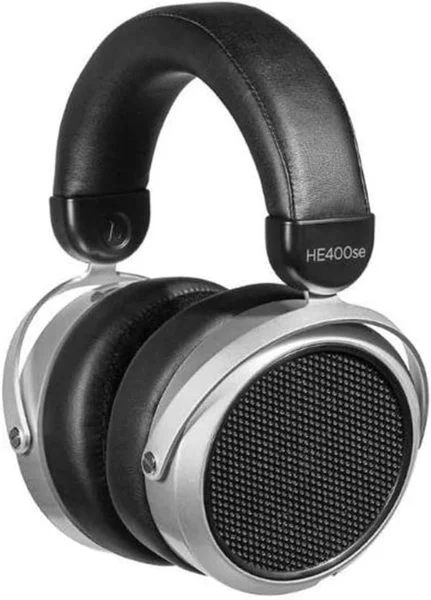
The HiFiMAN HE400SE needs about 80 mW at 25Ω for 110 dB peaks and roughly 320 mW to have 6 dB of headroom — with 56–113 mA of current behind it. That kills phone jacks and the Apple dongle, and it’s why the “25 ohms, must be easy” assumption leads so many buyers to think this planar is bass-light and dull.
Cheapest fix: FiiO KA5 dongle ($69) via 4.4mm balanced. Best desktop value: Schiit Magni Heresy or JDS Labs Atom Amp+ ($100). Best one-box: FiiO K7 (~$199) with a balanced cable. Best sound I’ve heard from it: Schiit Asgard 3. If you’re going to end up with a Sundara or Arya anyway, buy the THX AAA 789 once.
I own the HE400SE and every amp on the tier list, so the “in my listening” notes below are mine. The numbers come from the power math, not vibes.
Why the HE400SE is harder to drive than its impedance suggests
Two specs decide how hard a headphone is to drive: impedance (Ω) and sensitivity (dB/mW or dB/V). Most people only read the first one. The HE400SE is 25Ω — lower than an ATH-M50x — so it “should” run from anything. But it’s rated at 91 dB/mW, and that number is the story.
Convert to voltage sensitivity: 91 dB/mW at 25Ω is 107 dB/V. A Sennheiser HD 600 is about 102 dB/V at 300Ω; an ATH-M50x is around 113 dB/V. So per volt the HE400SE is louder than the HD 600 — but it draws that volt across 25Ω instead of 300Ω, which means 12× the current for the same voltage. It doesn’t need voltage. It needs current, and current is what small output stages run out of first.
Planar magnetic drivers make this worse in one specific way: their impedance is essentially flat and purely resistive, so the amp sees a constant 25Ω load at all frequencies. There’s no impedance rise in the bass to give the amp a break, which is exactly where dynamic headphones ease off. If you want the physics in more depth, my planar magnetic vs dynamic headphones guide covers it; for the impedance side, read what is headphone impedance .
The power math: what the HE400SE actually needs
Formula: V = 10^((SPL − S_dBV)/20), where S_dBV = 91 + 10·log10(1000/25) = 107.0 dB/V.
| Target | Voltage | Current | Power @25Ω |
|---|---|---|---|
| 100 dB (loud sustained) | 0.45 V | 18 mA | 8 mW |
| 110 dB peaks (my target) | 1.41 V | 56 mA | 80 mW |
| 110 dB + 6 dB headroom | 2.82 V | 113 mA | 318 mW |
| Output impedance rule | — | — | Z_out ≤ 25/8 ≈ 3Ω |
Two takeaways. First, 80 mW sounds trivial — until you notice that a phone or an Apple dongle tops out at roughly 1 V, i.e. about 40 mW into 25Ω and no headroom at all. Second, 113 mA of clean current is beyond what USB-bus-powered single-ended dongles deliver; balanced dongles get there because they double the voltage swing across the load.
How the amps stack up
Manufacturer figures at the nearest published impedance; “n/a” where a spec at that load isn’t published. Headroom is calculated against the 80 mW / 1.41 V requirement for 110 dB.
| Amp | Rated output (nearest to 25Ω) | Headroom vs 110 dB | Verdict |
|---|---|---|---|
| Apple USB-C dongle | ~1 V max, ≈30 mW @32Ω (ASR measurements) | −3 dB (can’t reach 110 dB) | Skip |
| FiiO KA3 | 130 mW SE / 240 mW bal @32Ω | +2 dB SE / +5 dB bal | OK balanced only |
| FiiO KA5 | ~128 mW SE / ~265 mW bal @32Ω | +2 dB SE / +5 dB bal | Good balanced |
| iFi Zen DAC 3 | ~210 mW SE / ~390 mW bal @32Ω | +4 dB SE / +7 dB bal | Good balanced |
| Topping DX3 Pro+ | ~1 W @32Ω | +11 dB | Pass |
| JDS Labs Atom Amp+ | 1 W @32Ω | +11 dB | Pass |
| FiiO K7 | ~1 W SE / 2 W bal @32Ω | +11 dB / +14 dB | Pass |
| Schiit Magni Heresy | 2 W @32Ω, 2.4 W @16Ω | +14 dB | Pass |
| Schiit Asgard 3 | 3.5 W @32Ω, 5 W @16Ω | +16 dB | Pass |
| Drop THX AAA 789 | 6 W @32Ω balanced | +19 dB | Pass (overkill) |
Everything from the DX3 Pro+ up passes with more than 10 dB of margin. The interesting zone is the dongles: single-ended they scrape past 110 dB with 2 dB to spare, which in practice means you’ll hear compression on kick drums at high volume. Balanced they’re fine.
Why dongles clip on the HE400SE
A USB-C dongle has a hard voltage ceiling set by its internal supply — around 1 V for the Apple stick, roughly 2 V single-ended and 4 V balanced for FiiO’s KA series. Voltage ceiling is what sets maximum SPL. When a track’s peaks ask for more voltage than the chip can swing, the waveform flat-tops. On a planar that shows up as bass that stays polite no matter how far you turn it up, and a sense that the volume knob “stops working” near the top.
The Apple dongle is the clearest case: ~1 V into 25Ω is 107 dB. You can listen at 90–95 dB average, but the 15–20 dB transients above that in well-recorded music are gone. That’s why so many people say the HE400SE “has no bass” from a phone. It’s not the headphone. If you want a pocket solution, buy a balanced dongle and a 4.4mm cable, or step up to a FiiO BTR7 — FiiO rates its 4.4mm output at ~320 mW into 32Ω, which passes with 6 dB of headroom.
Why low output impedance matters (even on a flat-impedance planar)
The usual argument for low output impedance is frequency response: a headphone whose impedance varies with frequency will change tonality when driven from a high-impedance source. Planars barely vary, so that argument mostly evaporates for the HE400SE.
The argument that still stands is voltage division. Any output impedance forms a divider with the 25Ω load. A 10Ω source drops 29% of its voltage before it reaches the driver — 3 dB gone, on a headphone that already needed all the voltage it could get. Console controllers, some motherboard jacks and OTL tube amps sit in that range or worse. Every amp on the tier list is well under 1Ω, so the rule (Z_out ≤ 3Ω for a 25Ω load) is easily met — just don’t try to run this on a Darkvoice.
Why balanced helps here (and where it doesn’t)
Balanced output on affordable gear typically doubles the voltage swing into the load and delivers roughly four times the power. On the FiiO K7 that’s the difference between ~1 W and 2 W into 32Ω; on a KA5 dongle it’s the difference between “barely enough” and “comfortable.” Because the HE400SE’s problem is headroom, balanced solves the actual problem on power-limited devices.
On a desktop amp that already puts 2–3.5 W into 32Ω single-ended — Heresy, Asgard 3 — a balanced cable buys you nothing measurable. I’ve A/B’d the K7’s 4.4mm against the Asgard’s 6.35mm at matched levels and I can’t reliably pick them. The balanced vs single-ended guide explains why, and the best balanced headphone amps roundup covers the options if you’ve decided you want the connector anyway. The HE400SE ships with a 3.5mm cable and dual 3.5mm cup connectors, so a balanced aftermarket cable is cheap and easy to find.
The amps, one by one
Apple USB-C dongle (~$9) — why not
ASR’s measurements show about 1 V RMS maximum output and roughly 30 mW into 32Ω, with an output impedance under 1Ω. Great DAC for the money; the wrong tool for a 91 dB/mW planar. It reaches 107 dB peaks at absolute best, so you’re living with zero headroom. Fine for IEMs and the ATH-M50x. Not for this.
FiiO KA3 / KA5 (~$60–70) — the pocket answer
Both have a 4.4mm balanced jack rated at 240–265 mW into 32Ω per FiiO, plus a 3.5mm at roughly half that. Balanced they clear the 110 dB target with 5 dB of headroom, which is enough for most listening. The KA5 adds a screen and hardware volume; the KA3 is smaller. Neither is a desktop replacement — the KA5 gets warm and pulls noticeable battery from a phone — but they’re what I’d take on a plane with the HE400SE. Use the 4.4mm.
JDS Labs Atom Amp+ (~$99) — the neutral desktop baseline
1 W into 32Ω, output impedance under 1Ω, and a noise floor you won’t find with a 91 dB/mW headphone. In my listening it’s dead neutral: the HE400SE sounds exactly like the HE400SE, no added warmth, no smoothing. Volume knob feel is the best in the price bracket. Pair it with the Atom DAC+ or a Topping E30 II and you have a complete stack under $210. Full notes in my Atom Amp+ review .
Schiit Magni Heresy (~$109) — the most current under $110
Schiit publishes 2 W into 32Ω and 2.4 W into 16Ω — the important number here is the 16Ω one, because it tells you the output stage keeps delivering current as impedance drops. Sub-1Ω output, gain switch, preamp outs. Sonically it’s as neutral as the Atom to my ears with fractionally more grip on kick drums at silly volumes. If you’ll only ever own low-impedance planars, this is the pick. My Magni Heresy review has more, and the Heresy vs Atom Amp+ comparison settles the $100 question.
Topping DX3 Pro+ (~$149) — the one-box neutral combo
My reference desktop DAC. Around 1 W into 32Ω from the 6.35mm jack, an ES9038Q2M DAC that measures superbly, LDAC Bluetooth and a remote. It drives the HE400SE with 11 dB of headroom and the pairing sounds crisp and slightly forward — the ESS chip’s clean top end doesn’t soften the HE400SE’s treble grain, so if you’re treble-sensitive read the Zen DAC 3 entry. Best pick if you want zero boxes on the desk. DX3 Pro+ review ; compare with the K7 in DX3 Pro+ vs FiiO K7 .
FiiO K7 (~$199) — the balanced combo I recommend most
Balanced 4.4mm and XLR at 2 W into 32Ω, ~1 W single-ended, AKM DAC, RCA preamp out, three gain settings. With a $20 balanced cable the HE400SE gets 14 dB of headroom and, in my listening, the AKM stage sounds a touch fuller through the mids than the Topping — a good match for a planar that’s slightly dry. If you plan to upgrade to a Sundara later, the K7 stays relevant. FiiO K7 review and K7 vs Magni Heresy if you’re torn between combo and separates.
iFi Zen DAC 3 (~$149) — the warm alternative
Balanced only for this headphone: iFi’s ~390 mW into 32Ω from the 4.4mm passes with 7 dB of headroom, but the single-ended jack (~210 mW) leaves you at 4 dB. The Burr-Brown DAC has a softer, rounder character than the ESS/AKM units above, and the XBass switch adds real sub-bass lift — with the HE400SE’s gentle roll-off below 40 Hz, that’s a useful button. If the HE400SE strikes you as thin or clinical, this is the combo that changes it. Zen DAC 3 review ; Zen DAC 3 vs DX3 Pro+ if you’re choosing between the two.
Schiit Asgard 3 (~$199) — where the HE400SE sounds best to me
3.5 W into 32Ω, 5 W into 16Ω, Class A-biased output, optional internal DAC card. On paper the Heresy already has enough power; in my listening the Asgard has a bit more body in the lower midrange and a firmer grip on bass transients — small but consistent, and it flatters a headphone that leans lean. It runs warm and it’s bigger than a Magni. It’s what the HE400SE lives on at my desk. Asgard 3 review .
Drop + THX AAA 789 (~$299) — the amp you don’t outgrow
6 W into 32Ω balanced, three gain settings, and distortion figures that ASR still uses as a reference. For the HE400SE alone it’s overkill by 19 dB. Buy it if you know a Sundara, Arya or Edition XS is next — with the 789 in place you never re-buy the amp, only the DAC. It has no DAC, so add a DX3 Pro+ or E30 II. THX AAA 789 review .
Amp character: does the HE400SE care about warm vs neutral?
Less than a Beyerdynamic DT 990 Pro, more than an HD 600. The HE400SE’s tonal balance is close to neutral with a slight lower-midrange dip and a hint of grain in the upper treble. Neutral amps (Atom, Heresy, DX3 Pro+, 789) present it exactly like that. The warmer options — Asgard 3’s Class A bias, Zen DAC 3’s Burr-Brown DAC plus XBass, K7’s AKM stage — add a bit of weight through the mids and bass, and in my listening the HE400SE is more enjoyable with that little bit of help.
Tube amps are the exception: OTL designs have output impedances of 30–120Ω, which will drop most of their voltage across themselves into a 25Ω load and roll off the bass. If you’re curious about tubes, use them with 250–300Ω dynamics; my tube vs solid-state guide explains why.
Skip this pairing if…
- You want to run the HE400SE from a phone with no extra hardware. It’ll be quiet, compressed and bass-shy. Either buy a balanced dongle or buy an easier headphone — the ATH-M50x or Sennheiser HD 560S run from anything.
- You already own a Sundara. Same amps apply; go read the Sundara pairing guide — the Sundara is 3 dB easier and the priorities shift.
- You want a tube amp. Not with a 25Ω planar. Get a DT 990 or HD 650 for that.
- You expect an amp to fix the treble. It won’t. EQ or a different headphone will.
- You’re on a strict $150 total budget. Get the HE400SE plus a KA5 (balanced) rather than the HE400SE plus a $30 no-name amp; or consider the best planar magnetic headphones under $300 for a headphone-first spend.
What owners say
Reading a few years of HE400SE threads, the consensus is remarkably consistent: people who bought it as their first planar and ran it from a laptop were underwhelmed; people who added a $100 desktop amp or a balanced dongle describe the same headphone as a bargain. The most common “amp upgrade” reports are Heresy/Atom → Asgard 3 or K7-balanced, with owners describing tighter bass and more punch, and almost nobody claiming a change in treble or soundstage. Complaints center on the stock cable, headband comfort with the pre-2023 headband, and treble grain — none of which an amplifier touches. The Sundara is the standard “next step,” and the HE400SE vs Sundara comparison is the article to read before you spend that money.
My recommendation by budget
| Budget | Buy | Why |
|---|---|---|
| Under $80, portable | FiiO KA5 (4.4mm) | Only sub-$80 option that clears 110 dB with headroom |
| ~$100, have a DAC | Magni Heresy or Atom Amp+ | 1–2 W into 32Ω, both neutral; Heresy for more current, Atom for the knob |
| ~$150, no DAC | Topping DX3 Pro+ (neutral) or iFi Zen DAC 3 (warm, balanced) | One box, ~1 W / ~390 mW respectively |
| ~$200, no DAC | FiiO K7 + balanced cable | 2 W balanced, AKM DAC, upgrade-proof |
| ~$200, have a DAC | Schiit Asgard 3 | Best sound from the HE400SE I’ve heard under $300 total |
| $300+ | THX AAA 789 + DX3 Pro+ or E30 II | Never buy another amp |
Whichever tier you pick, spend the rest on music. The HE400SE at ~$150 plus a ~$100 amp is still one of the best value chains in headphones — it just isn’t a plug-into-your-phone headphone, and no amount of forum optimism changes the current draw.
Related reading: my HiFiMAN HE400SE review , the HE400SE vs Sundara comparison, do I need a headphone amp? , and the best headphone amps under $200 if you want a wider field than the nine amps above.
Want the full breakdown on this headphone? Read our in-depth HiFiMAN HE400SE Review .